

What if authentic souvlaki isn’t about following one fixed recipe? It’s easy to get mixed messages when one person means grilled meat on a skewer and another means a pita wrap. What makes souvlaki authentic is the balance of simple preparation, grilled flavour and a familiar way of serving it, not one topping or regional version.
Traditionally, souvlaki is made with small pieces of meat cooked on a skewer, often over charcoal. Names and serving customs vary across Greece, and extras such as chips in a wrap have become common too. There isn’t only one right way to enjoy it.
This guide explains the idea behind souvlaki, how it differs from gyros, and which ingredients, cooking methods and serving choices shape its character. You’ll come away better able to recognise the traditions behind Greek street food, whilst feeling free to explore the versions you enjoy locally.
Key Takeaways
- What makes souvlaki authentic is a balance of preparation, flavour and serving style, not a single strict recipe.
- Regional names and serving customs can differ across Greece without changing the dish’s roots.
- Grilled meat, seasoning and accompaniments work together, while modern twists can change the final serving.
- Clear menu descriptions help you understand how souvlaki is prepared and choose a version that suits your taste.
- Explore Greek street food from Street Souvlaki, serving Havant, Portsmouth, Emsworth, Hayling Island, Cosham and Waterlooville.
What makes souvlaki authentic? Start with the dish, not a checklist
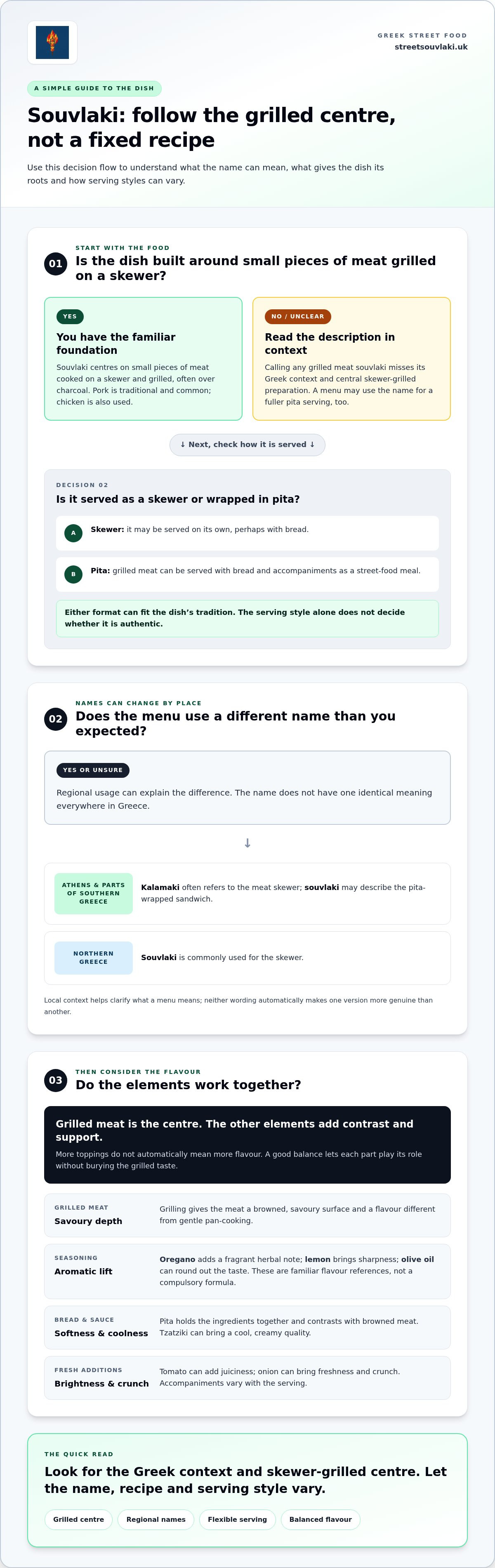
Souvlaki is Greek street food built around small pieces of meat grilled on a skewer. That gives you a useful starting point, but it doesn’t mean every authentic version must look or taste exactly the same. The word can refer to the skewered meat itself or, in some contexts, a fuller serving wrapped in bread.
That variation can be confusing if you expect one fixed definition. In Athens and parts of southern Greece, the meat skewer is often called kalamaki, meaning “little reed”, while souvlaki may describe the pita-wrapped sandwich. In northern Greece, souvlaki is commonly used for the skewer. The History and Definition of Souvlaki offers more background on the name and its different uses.
What does souvlaki mean in Greek food?
The familiar foundation is meat cut into small pieces, placed on a skewer and grilled. Traditionally, pork is common, with chicken also used. The skewer might be served on its own, perhaps with bread, or as part of a pita serving with accompaniments. The same word can therefore refer to the grilled centre or to the street-food meal built around it.
That distinction matters when reading a menu. A description of souvlaki might mean chunks of meat cooked on a skewer, while a pita version brings the grilled meat together with bread and other ingredients. Neither wording automatically makes one more genuine than the other. The local context helps explain what the name means in that setting.
Does authentic souvlaki have one fixed recipe?
No single recipe defines every version. Families and regions can have their own ways of seasoning, grilling and serving souvlaki, and contemporary cooks may make different choices too. Those differences sit alongside a recognisable idea: small pieces of meat cooked on a skewer and enjoyed as Greek food.
It’s more useful to look for that foundation than to judge authenticity by a rigid checklist. A pita, a particular garnish or one exact seasoning isn’t the whole story. Serving customs shift, and personal preferences differ, without erasing the dish’s roots. At the same time, calling any grilled meat souvlaki would miss what makes the dish recognisable: its Greek context and central skewer-grilled preparation.
In short, what makes souvlaki authentic is its connection to a familiar Greek way of grilling and serving meat, with room for regional language and variation. This is a practical way to understand the dish, not a claim that every Greek cook follows the same tradition. It gives you a clear base for exploring the flavours and serving styles that make each version its own.
The souvlaki flavour balance: how the elements work together
A satisfying souvlaki serving depends on how its parts come together. Grilled meat brings savoury depth, seasoning adds aroma, and bread or accompaniments can soften, brighten or contrast with each bite. Each element has a role, so more toppings don’t automatically mean more flavour.
How grilled meat and seasoning shape the flavour
Grilling gives meat a browned, savoury surface and a flavour different from gentle pan-cooking. Seasoning should complement that character rather than hide it. Oregano adds a fragrant herbal note; lemon brings sharpness; olive oil can round out the taste. These are familiar Greek flavour references, not a compulsory formula for every cook or region.
The balance can shift with the meat and how it is prepared. A strongly seasoned piece may need little extra, whilst lighter seasoning leaves more room for accompaniments to stand out. There’s no single seasoning blend that defines every authentic souvlaki. What matters is that the flavours work together and let the grilled meat remain part of the experience.
Why bread, sauces and accompaniments matter
Pita can turn skewered meat into a handy, filling street-food meal. It holds the other elements together, and its soft texture contrasts with meat browned by grilling. A sauce such as tzatziki is a familiar partner: its cool, creamy quality can balance savoury meat and aromatic seasoning. Tomato or onion can add freshness and crunch, though serving choices vary.
Freshness is more than a menu label. Think about contrast: crisp onion against soft bread, juicy tomato beside savoury meat, or a cool sauce with warm grilled flavours. Differences in texture, aroma and temperature help each bite feel complete. If every element is rich, the serving may feel heavy; if everything is mild, it may lack contrast.
Good souvlaki balance lets each element play its part, rather than burying the grilled flavour under toppings. That doesn’t mean fewer accompaniments are always better. Each addition should suit the serving and bring something useful, whether that’s freshness, softness, crunch or a change in flavour.
As you explore Greek street food, notice how the meat, seasoning, bread and accompaniments work together instead of judging a serving by one ingredient alone. For more context on familiar ingredients, look at how each one contributes flavour, texture or freshness. You can also explore Greek street food locally and decide which combinations appeal to you.
Traditional souvlaki and modern versions: what can change without losing its roots?
Tradition doesn’t mean every souvlaki has to be served in the same way. Across Greece, cooks and local food businesses make different choices about meat, seasoning and accompaniments. A skewer served simply with bread and a pita filled for eating on the move can both fit within the dish’s street-food tradition. The format may change, whilst the familiar grilled centre remains.
A modern takeaway wrap isn’t automatically inauthentic. Convenience describes how a meal is served, not whether its culinary roots have disappeared. It’s more helpful to consider what the food is built around and how its parts work together than to treat one presentation as the only genuine one.
| Traditional cue | Possible modern adaptation | What to notice |
|---|---|---|
| Grilled meat served on a skewer | Meat presented in a pita for an easy-to-eat meal | The preparation remains centred on grilled meat |
| Simple seasoning | A different seasoning balance or flavour emphasis | Seasoning complements the meat rather than defining one fixed recipe |
| A modest set of accompaniments | Additional toppings or a changed combination | Each element still contributes to the overall serving |
Which parts of souvlaki can vary by place or preference?
Meat choice, seasoning and accompaniments can all vary. One cook may prefer simple seasoning that lets the grilled flavour stand out; another may serve the meat with a fuller mix of sauces or vegetables. Preferences also shape whether someone chooses a skewer or a bread-based serving. Greece has many local food traditions, but it isn’t useful to assume every town or family follows one standard. Variation is part of how a familiar dish is enjoyed, not proof that one version is lesser.
Souvlaki and gyros: related, but not interchangeable
The key difference is the cooking format. Souvlaki uses pieces of meat cooked on a skewer; gyros uses seasoned meat cooked on a vertical rotisserie and shaved into slices. Both are found in Greek street-food settings, and both may be served with similar accompaniments, such as tomato, onion, sauce or chips. Those overlaps can make the names seem interchangeable, but the way the meat is cooked distinguishes the dishes.
So what makes souvlaki authentic isn’t whether it follows one fixed presentation. Look for a clear connection to its grilled-meat roots, then allow for changes in serving style and personal taste. That gives you a fairer way to appreciate traditional and contemporary versions alike.
How to recognise authentic souvlaki when ordering
A useful menu tells you more than simply claiming that something is “authentic”. Look for clear information about the cooking style and how the food is served, then decide whether the combination sounds right for you. There’s no need to test a meal against a strict set of cultural rules. The aim is to understand what you’re choosing and enjoy it.
What can a menu description tell you about souvlaki?
Specific wording helps set expectations. A description that says meat is grilled on a skewer tells you more about the preparation than a general label such as “Greek-style”. Details about bread, sauces or other accompaniments help you picture the serving and its flavour balance. Greek-themed decoration may create atmosphere, but it can’t tell you how a dish is prepared. Nor does one adjective prove authenticity on its own.
Use what’s actually described rather than filling gaps with assumptions. If a menu doesn’t name an ingredient or cooking method, don’t assume it’s included. Clear descriptions are helpful because they explain the food, not because they need to meet a purity test.
Which questions help you choose a serving you will enjoy?
Before ordering, follow this simple sequence. It keeps the focus on the dish and your preferences:
- Understand the format. Are you looking for skewered grilled meat, or a fuller serving in bread?
- Read the description. Notice what it says about preparation and listed accompaniments.
- Think about balance. Would you enjoy fresh, crisp additions alongside savoury grilled flavours, or a simpler combination?
- Choose for your appetite. Consider whether you want a lighter option or a more filling meal, based on the serving described.
That’s enough to make a confident choice. You don’t need to decide whether a dish is “Greek enough” based on a garnish, a restaurant’s look or a bold authenticity claim. What makes souvlaki authentic is a useful question for understanding the dish’s roots, but ordering is also about choosing a version whose preparation and accompaniments appeal to you.
Quick check: understand the format, read the details, consider the balance, then choose what you’ll enjoy. Customer reviews can help you learn about other people’s experience, while details such as cooking style tell you more about the food itself. They serve different purposes.
Use that approach as you browse Street Souvlaki’s Greek street food menu, then choose a serving that suits your taste.
Enjoy authentic Greek street food locally with Street Souvlaki
Knowing what makes souvlaki authentic gives you a better way to understand the food, but you don’t need to settle every question before enjoying a meal. The traditions offer useful context, and your own taste matters too. Street Souvlaki serves Greek street food to customers in Havant, Portsmouth, Emsworth, Hayling Island, Cosham and Waterlooville, so you can explore Greek flavours locally.
Use the ideas in this guide as a helpful starting point, not a strict test. Look at how dishes are described, consider the preparation and serving style, then choose what sounds satisfying. There’s room to appreciate Greek food traditions whilst enjoying the version that suits you.
A local way to explore Greek street food
Street Souvlaki serves Greek street food across the local area. You can browse the menu and see what appeals without needing to know every regional name or settle on one definition of authenticity first. Dish descriptions help you make an informed choice, while the wider tradition gives you context for what you’re exploring.
Authenticity isn’t proved by a single label or by claiming every serving follows one recipe. It comes from understanding the food’s cultural roots and recognising that Greek street food can be enjoyed in different ways. Exploring a local menu lets you put that understanding into practice at your own pace.
What to expect when ordering directly
Street Souvlaki accepts direct online orders through its website. The site also offers order tracking, customer reviews and loyalty rewards, giving you practical ways to follow an order, read other customers’ experiences and access the rewards available there. These features support the ordering experience, but they aren’t proof of a dish’s authenticity. For that, focus on the food and the information provided about it.
Reviews can offer a sense of other people’s experience, whilst menu descriptions help you understand what you’re choosing. Keep those roles separate: one tells you about customer feedback, the other gives you details about the food. Then make your choice based on what sounds good to you, whether you’re already familiar with Greek street food or trying it for the first time.
You don’t need a perfect checklist to enjoy a meal. Bring your curiosity, browse with confidence and choose a serving that fits your taste. Explore the menu and order directly from Street Souvlaki.
Let your next meal be part of the discovery
You don’t need to settle on one strict definition before trying Greek street food. Treat what makes souvlaki authentic as a starting point for curiosity, then let your own tastes guide what you choose. A menu can be an invitation to discover a new flavour or revisit a familiar favourite, without turning the meal into a test.
Street Souvlaki makes that next step straightforward with direct online ordering. The website also offers order tracking, customer reviews and loyalty rewards, so you can browse, place an order and use these features in one place.
Choose something that appeals, enjoy it in your own way and stay curious about the traditions behind Greek street food. Explore the menu and order Greek street food from Street Souvlaki.
Frequently Asked Questions
Is souvlaki always made with pork?
No. Pork is a traditional choice, but chicken is also commonly used, so the name doesn’t point to one meat alone. When comparing menu options, check the description for the meat named rather than assuming it from the word “souvlaki”. That’s especially useful if you have a preference or dietary requirement, as a dish name by itself may not tell you every ingredient.
Does authentic souvlaki have to be served in pita?
No. Pita is a familiar way to serve souvlaki, but it isn’t essential. You may also see the grilled meat served on its skewer, with bread alongside. Think about how you want to eat: a wrap is handy if you prefer everything together, whilst a skewer lets you enjoy the meat and bread separately. The serving format doesn’t, on its own, decide authenticity.
Can souvlaki be authentic if it is served as takeaway?
Yes. Takeaway is a way of serving and enjoying food, not a measure of its cultural roots. A Greek street-food meal doesn’t become less authentic simply because you eat it away from the place it was prepared. If you’re ordering to enjoy later, consider which format suits you and read the menu details so you know what the serving includes.
How is souvlaki different from gyros?
The main difference is how the meat is cooked and served. Souvlaki uses pieces of meat cooked on a skewer, whilst gyros is cooked on a vertical rotisserie and shaved off in slices. Both can be served in a pita with familiar accompaniments, so the wrap alone may not tell you which dish you’re looking at. Check whether the description mentions skewered pieces or rotisserie-cooked meat.
What makes Greek souvlaki taste distinctive?
Its flavour comes from the way grilled meat, seasoning and accompaniments meet, rather than from one ingredient that must appear in every version. Grilling gives the meat a savoury character; familiar Greek seasonings such as oregano, lemon and olive oil can add herbal, bright or rounded notes. The exact taste varies, so look for a combination that sounds balanced and appealing to you.
Is there only one authentic way to make souvlaki?
No. There isn’t one recipe or serving style that every Greek cook follows. Meat, seasoning and accompaniments can vary between households and places, and modern versions can still reflect the dish’s roots. What makes souvlaki authentic is best understood through its connection to Greek food traditions, not a strict checklist. Differences are a reason to explore, rather than a reason to dismiss a version.
Can I order Greek souvlaki locally around Havant?
Yes. Street Souvlaki serves Greek street food to customers in Havant and across its local area, including Portsmouth, Emsworth, Hayling Island, Cosham and Waterlooville. You can place an order directly through the business website. The site also has customer reviews, order tracking and loyalty rewards, giving you useful information and features as you browse and order.
